
Firstly I’d like to say a huge “thank you!” to everybody who took the time to enter my eBay ‘spot the differences’ contest (if you missed it you can check it out here.) I am absolutely delighted with the number of people who took part and the quality of the entries was superb.
It was a very difficult job to choose one winner but the detailed analysis in Lynn Norton’s entry just clinched it!
So congratulations to Lynn!
Lynn chose a copy of my eBook “20 ways to make money now on the internet” as her prize.
Here is my list of the main differences (those that I believe had the most impact on the success of the auction):
(in no particular order)
Category
“Art>prints>modern (1900-1979)>open editions” is a very poor category choice for a rare print that was published in 1902.
Yes, the date fits but the category suggests the item is a mass produced, modern reproduction.
I chose “Art>prints>antique (pre-1900)>sporting” because the word “antique” adds to the perceived value of the print (and I know from experience that sporting memorabilia is very sought after).
Now you may feel that I have misled my buyer because the print is not “pre-1900” but remember I am not selling a page taken from a book published in 1902 (as my competitor is)
I am actually selling a scarce art work that was bought at an estate sale and I estimate its period to be circa 1900.
My buyer certainly didn’t feel misled, click HERE to read the feedback they left (this buyer invested in two prints).
Title
The key to a successful title is to fill it with the keywords that your target market are searching for.
My competitor has clearly not done his homework and he has simply described what he sees which is a “fox running”.
A little research on eBay would have shown him that “fox” isn’t a hot keyword but adding the word “hunt” or “hunting” (or both) makes it very hot indeed!
Images
Never try to cut costs by just including one image, I always try to show off every point of interest in my prints and uploading them to eBay (as opposed to self hosting them) may cost more but it does give you the added benefit of the ‘enlarge’ feature.
Opening Price
My ‘opening price’ policy is a result of extensive testing of various opening price levels.
Many eBayers will tell you that a low, low opening price will attract more bidders and result in higher final values and whilst this may be true for some items on eBay it is certainly not true for vintage prints.
A higher start price adds to the perceived value of the print and my advice is to start high, if your print doesn’t sell first time then relist it with a slightly lower price and so on until you find the optimum opening price for your item.
My competitor chose a different price for each of the prints he listed (although they all came from the same book) which suggests to me that he had no idea of the value of what he was trying to sell.
Auction End Time
Some eBayers claim that a different end day/time makes no difference to their final values but my experience tells me that 7 day auctions that start and end Sunday afternoon perform better than those ending on a week day evening.
Item Specifics
Again my competitor shows he is not familiar with his target market by describing the subject of the print as “animals”. He also devalues it by describing it as “unsigned” when his images clearly show a printed signature.
Description
My competitor devalues his print by revealing that it is merely a page from an old book, he then goes on to highlight the negative points that it has creasing and staining and isn’t mounted.
In contrast my description is all about talking up the value of the print by using words like; scarce, original, professionally, beautifully, fine, exceptionally.
I always try to ‘connect’ with the potential bidder by telling a story which further enhances the uniqueness of the item.
Return Policy
My strongly worded return policy totally removes the risk from the buyer. For me this is the most important piece of information (after the title) on the page.
Don’t worry about offering a ‘no quibble guarantee’ on your auctions, it will not lead to more refund requests but will definitely lead to more bids!
There are several other minor differences including postage rates, feedback scores, payment methods and item location but the above are the areas that I feel contributed the most to the success of my auction.
————————————————-
As an interesting footnote to this story I guessed that my competitor might be feeling a little frustrated with the results of his auctions compared to mine so I sent him a message (through one of my other eBay ID’s) posing as a collector and negotiated a price of $425 for his remaining 18 prints from this book. So now I have an additional 18 prints to sell bought with the proceeds from just 2 of my own sales and I have eliminated my competition!
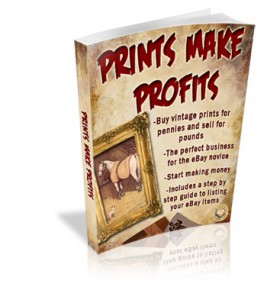
Don’t forget you can learn all of my eBay profit secrets in Prints Make Profits my step by step guide to sourcing and selling vintage prints on eBay and you can grab your exclusive subscriber discount by clicking the eBook cover graphic here>
 | Want 5 easy side hustles? Get your FREE guide: "5 Easy Etsy Product Lines You Can Do Right Now!" |



Hi Stuart
I just wanted to let you know how much I enjoyed reading my prize "20 Ways to Make Money Now on the Internet". I wasn't expecting more than a brief outline of each idea, so I was pleasantly surprised by the amount of detail that was included.
It was also nice to see that most of these businesses could be started with little or no money upfront, no website, no list, no previous experience and no technical ability beyond basic computer skills.
Anyone who doesn't know where to begin making money on the internet would be spoilt for choice after reading this book. I know I certainly am!
Thanks again, Stuart.
Warm Regards
Lynn
Thanks for the positive feedback Lynn and I'm delighted you enjoyed the book!
I'm currently working on adding new ideas to the book and all previous buyers will receive these updates free.
I missed out having just found this site. I am now thinking of setting up my own competition. I am not going to invite anybody though, because I am a really bad loser. Joke on the side, I think having a comp of some sort is a really good idea. I must try it out on my readers.
Some great eBaying tips there. I've just found this blog, but it looks really helpful – I make an income online myself, but I am always looking for new ways to make money.
Well done to the winners.
Lovely sumation of the contest and the Pro's and Con's of the differences that made your sale much higher than the competition.
Anyone who reads this blog post will benefit from what you have described as the top selling reasons of the sale.
Your book gave me such an insight of a niche that i had never contemplated and i would recommend the book to any of those people out there that are looking for a market to get into.
Also Congratulations to the winner Lynn. I know that she will truly find the book she chose both enlightning and useful for future work.
Vince
Hi Stuart
Thank you so much for choosing my contest entry as the winner, I am so excited to have won!
I really enjoyed comparing the two auctions. Not only was it a lot of fun, but it also served as a reminder of the points to keep in mind when writing my own listings.
I always look forward to your newsletter and blog posts, as not only are you a fellow UK eBayer and marketer, but you are one of the few who generously share your knowledge and experience without bombarding us with promotions for the latest shiny object. So thank you for that, and keep up the good work.
Warm Regards
Lynn