

Todays newsletter is all about selling on Amazon!
Let me start by saying that I am a complete newbie when it comes to Amazon, I have purchased the occasional book from Amazon but I have never used the site to sell anything. There is currently a huge halabaloo about selling on Amazon and the FBA (fulfillment by Amazon) program and I thought it was time I took a closer look and shared my observations and conclusions to help you decide whether this is an opportunity for you.
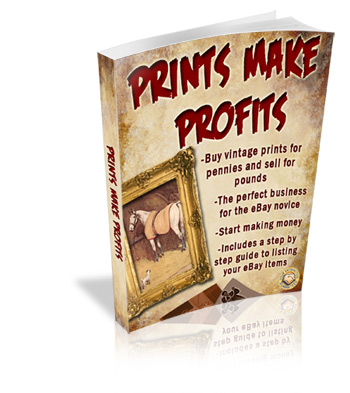 As you know I have been selling one-off collectible items (original vintage prints) on eBay for several years and during this time eBay has gradually moved the goal posts.
eBay’s policy has been one of charging more and more and yet providing less and less.
When I first started selling on eBay my total fees (listing, final value and PayPal) were around 10% of the sale price of my prints, today I pay around 16.5%. A huge increase of 65%!
During this time other sales platforms have grown in popularity (most notably Amazon) and eBay has resorted to ever more desperate ways to hold on to its market share (for example its strict linking policies designed to control where its visitors make their purchases).
These policies have alienated huge numbers of sellers who have been leaving eBay and seeking out alternative platforms in their droves.
So Amazon provides a way for the eBay seller to reduce their dependence on eBay and diversify the way they sell their products resulting in a much stronger (all eggs NOT in one basket) business.
Pricing Comparison
 If you are considering selling your products on Amazon I recommend you check out the various different pricing plans here;
The first thing you will notice is that there are two different selling plans, the individual seller and the professional seller.
Professional sellers pay a monthly fee ($39.99 on the US site) plus a referral fee which is a percentage of the product price and varies from 8% up to 15% depending on the category of goods sold (there is also an additional fixed fee of between 80 cents and $1.35 for items in the ‘media’ category)
Individual sellers do not pay the monthly fee but instead pay a fixed fee of 99 cents on every item sold plus the referral and media fees detailed above.
If you expect to sell more than 40 items per month you will be better off as a professional seller. Another consideration is whether you want to sell items that are not already in the Amazon catalogue. Sellers of one-off collectible items like myself need to sign up as professional sellers because individual sellers can only sell items that are already in the Amazon catalogue.
There are no ‘listing fees’ as such so small volume individual sellers can list their stuff for free and only pay after they have made a sale.
I have compared the Amazon (UK) and eBay (UK) fees for my vintage prints and based on a typical $75 sale I would pay 16.45% to eBay and 19.08% to Amazon (just shy of a $2.00 difference).
Do also bear in mind that your items are listed at a fixed price on Amazon which I feel is a distinct disadvantage for sellers like myself who rely on eBay’s auction system to establish the value of their items. This also means that you won’t benefit from the occasional unexpected windfall of a bidding war.
The Amazon Buying Experience
One of the major reasons for Amazon’s success is its strong focus on customer service.
Unlike eBay where the buyer is transacting with one of many different sellers who may each offer different delivery times, different returns policies etc. Amazon buyers know exactly what to expect when they purchase their items and they are prepared to pay a premium price for the ‘Amazon buying experience’.
This is an opportunity for the eBay seller to obtain higher prices for their goods.
Fulfillment By Amazon (FBA)
 FBA allows small sellers to compete with the big boys by leveraging Amazon’s economies of scale.
Because Amazon stores and ships many millions of items their costs per item are extremely low and FBA allows you to enjoy these cost savings in your business.
With FBA you simply box up your inventory and ship it to Amazon’s warehouse (benefiting from Amazon’s very low shipping rates) they store it and when it is sold (you can sell it through ANY sales platform including eBay and still use FBA) they pick it, pack it and ship it.
This frees your time to concentrate on the more profitable parts of your business such as sourcing new inventory (or you can take a long vacation without having to put your business on hold).
It also means that you can sell in much higher volumes than when you have to do all of the storing, packing and shipping yourself and you can add lower margin products to your range that would not be profitable at low volumes.
My Conclusions
If you rely on eBay for a large proportion of your income then I strongly recommend you take a closer look at the Amazon opportunity. You are in a potentially vulnerable position if you have all of your eggs in one basket.
I do feel that low volume sellers of one-off collectible items (like myself) are more suited to the eBay model than Amazon for the reasons mentioned in ‘Pricing comparison’ above.
I believe that the FBA program represents a unique and massive opportunity for the little guy to build a substantial online business and in my next post I will be exploring this opportunity in more detail.
If you are using Amazon as a sales platform I’d love to hear about your experiences so do please leave a comment. You can also leave a comment if you have any Amazon related questions.
 | Want 5 easy side hustles? Get your FREE guide: "5 Easy Etsy Product Lines You Can Do Right Now!" |



Hi Stuart
Great comaparison of eBay and Amazon, gives some great points to consider before deciding which is the better platform to start out on.
I am at very early stages with both of these giants and having a play around to see how it all works.
Wendy makes a great point of spreading your net wide and try to acccess as many different selling platforms as you can for your products, thi swould also help to avoid getting affected to much by policy chnages at the big 2.
Cheers
Zahid
Hi Stuart,
Thanks so much for your post.
I’ve been selling eBay on and off for almost 5 years now, and have become increasingly uncomfortable with having all my eggs in one basket, not to mention the fact that I have no control over the changes eBay makes.
I look forward to your next post regarding Amazon so that I can learn a little more about it.
Thanks so much!
MIchelle
Thank you all for sharing your Amazon trading experiences, my post certainly seems to have touched a nerve!
As I said I’m very much an Amazon newbie so I’ve asked Deb Henry (my personal Amazon expert!) to answer the questions raised.
Thanks Deb!
Stuart
I tried selling recently on Amazon as an alternative to eBay. For the items I was selling, the sales price tended to be higher on Amazon, which is good. For me though, my low volume didn’t justify the $39.99 per month they charged. Once I pick up the volume, I’ll probably get back on it though.
In the meantime, I do have lots of books that can be boxed up and sent off under the FBA program, so I’ll give that a try soon.
Mike
Hi Stuart,
I found when I sold on Amazon it cost me more for shipping than they allowed for shipping. I don’t know how they figure it, but it comes up short from what it costs out of pocket, in my experience.
eBay is also getting outrageous when it comes to their fair share of the pie. I understand some folks may be padding their handling fees to make up for lost profits on the other side, but still to charge a value added fee for shipping is a bit over the top.
Oops. I guess I am whining here and be grateful we can sell anything on either of these giants without them claiming all of what it sells for. They are becoming like the IRS. How much did you make. Pay it here.
Thanks for listening.
Haggard
Hi,
Thanks for your post on this. I do sell on ebay and have been considering the amazon FBA programme. My question is this. If I send my inventory to amazon, and probably sell it again on ebay, how do I request amazon to fulfil my ebay order. Do I have to purchase it from myself again on amazon to get the order fulfilled. I will just like to know so I don’t get stuck in a rut. Thanks for your help
Regards
Ade
Hi Stuart – Happy St. Patrick’s Day to you … I know this is a huge holiday where you are.
I’m on the opposite side of the coin – total newbie to selling products on Amazon! I’ve been digging deep into the opportunities Amazon is offering and did enjoy your thoughts.
After reading through the comments – I can see that you have your work cut explaining the options that Amazon offers to those that think “outside the box”. Selling books, toys and clothing etc. and the like… that’s where the competition is already established.
I – on the other hand – am looking for the opportunities that have low competition and high price points. I found one – but it’s in the clothing niche and I already know that selling clothing is going to take more effort to get approved than I’m willing to put forth… just to get started.
I’ve been brainstorming alternatives with Debbie Henry and I think we might have a winner. We are still researching. 🙂
I’m looking forward to the next part of your review. It looks (to me) as if you are stepping outside your comfort zone and searching for other options and opportunities as well.
Thanks for all you do…
Hi Styart, nice post but there is something you may not be familiar with relative Amazon customer service. If you purchase from a third party marketplace seller then you must deal with that seller and not Amazon.
Also the Amazon A-to-Z guarantee does not apply. You are subject to the thrid party sellers qarranty or guarantee. This may turn out to be an unpleasant experience as it was for me.
I purchased a new HP printer from a thrid party seller. The printer was new but did not work properly. The seller basically told me to pound sand – it was not their problem and I should contact HP.
When I submitted an return request to Amazon I essentially got the same reply – pound sand – not our problem – contact the seller directly.
I suppose the Latin phrase applies – caveat emptor – buyer beware.
I have recently started selling Antique Prints on eBay and already sold a few. But I feel very limited by being in the UK. I have tried to find out how I can sell in other countries and have now added ‘Sell Worldwide’ to my listings, but doubt if anyone abroad sees them. Reading the info on eBay it seems that if you are selling products based in the UK you cannot advertise on ebay.com. This seems strange. Can someone please point me to a definitive guide to how to go about selling elsewhere.
Thanks
John
John, I am also in the uk and often list and sell on ebay.com. Dont bother with the “sell worldwide” choice as it often costs more than just a listing fee for ebay.com. Simply log in to ebay.com with your regulare username and password (this will log you in to any ebay site worldwide) and list your item as normal. Thats all there is to it.
It’s refreshing to find someone of your caliber who is NOT jumping on the Amazon (specifically FBA) wagon right now. There is a lot of buzz about FBA, but like you, as I’ve considered it for my business, I keep coming up short. Half of what I sell on eBay is clothing. It is very difficult to be authorized to sell clothes on Amazon. The other half of what I sell is toys, and I do already sell those on Amazon, as well as eBay. I actually sell toys on Amazon quicker and for higher prices than eBay, especially at Christmas. I have been reluctant to go all out with FBA however, even though I have been invited by Amazon on several occasions to do so. Someone else mentioned the storage fees, and I too find that an issue, partly because toys tend to be bigger in bulk so would cost more to store. What I am finding though, is that I have more and more competition with the FBA folks who list the same product that I have. I might consider doing FBA at Christmas when I know I can move inventory quicker, and thus cut down on the storage fee factor.
At any rate, thanks for your thoughtful, honest opinion on this issue.
Hi,
Thanks for your very helpful Newsletter.
I have been a Silver Powerseller on ebay and sold books on Amazon for a couple of years. In the last year I feel there have been so many Courses on using Amazon that certainly the book market appears quite saturated and Profits are not possible like they used to be.
I actually had a large turnover on ebay, but made a LOSS at the end. I never did seem to to be able to keep my prices as competative as others who probably were buying massive volumes of stock.
It does seem to be the ‘little guy’ that suffers!
All that said, I STILL sell on ebay and STILL sell on Amazon and am continually looking for Niche items for that purpose.
Thanks again for all you helpful advice and stimulating comments.
Regards
Peter Heywood
Rossendale
Lancs
UK
Thanks for your great newsletters Stuart!
I have been a power seller of both commodity items and one of a kind items on EBay for over 2 years now and have also watched my fees go up with each eBay policy change. Their policy changes also cost me lost time, in a big way. Each change requires a reevaulation of business practices, a repricing of listings and sometimes a relisting of products. I have spent endless hours changing my listings to keep up with their latest “best practices.”
I think the best way to hedge against EBay’s contantly changing policies and contantly rising fees is to sell as wide as possible. To not keep all your eggs in one basket. Amazon and/or your own website are good places to start. Even if Amazon’s fees are similar, you will attract buyers that you would never get on EBay so your sales will only be higher.
I know this is difficulat for sellers of unique and one of a kind items—there is no other platform with as big of an audience as EBay. The auction format and ability to distinguish your item and your business like you can on eBay is important for these sellers.
Here is what I would like to see happen–as sellers of these unique items get more and more frustrated they are eventually going to move to new platforms. I am hoping that soon a new platform will emerge that competes with eBay and allows small sellers of unique and one of a kind items to sell, auction style, to a large audience.
So, sellers, where else can our unique items be sold?
In the meantime, again, I think Amazon is a viable opportunity for commodity type items and a good way to sell “wide” and gain customers.
Hi Stuart,
I’m in Australia so the Amazon FBA program is fairly useless here as the cost of sending items to the closest FBA warehouse would be expensive.
If I was to sell items from my home in Australia the postage fee that Amazon allows me charge would not cover the cost of the actual postage needed to send an item overseas.
And lastly to sell on Amazon you have to have a bank account in either the USA, UK or three other countries. I have yet to figure out how to open such a bank account when I live in Australia. (If anyone has any information on how to do this I would like to hear about it!)
As for eBay:- eBay Australia has just released their changes for April and May. One of them is the ‘feature’ of parcel tracking. I’m hoping that this is only optional not mandatory as the added expense of having to register each parcel would either take away from my profit or reduce my sales if I increased my postage costs or item costs. I would also say that it may stop me from selling overseas as registering a parcel that goes internationally is incredibly expensive and I doubt the buyer would pay the fee.
I look forward to reading your next installment to this subject,
Andrea
Stuart,
Let me start by saying I look forward to your Email every week. They’re always full of very good tips and techniques. Keep it up. Onto the Ebay vs Amazon dilemma. I am a Top Rated Power Seller on Ebay. I sell sports memorabilia and collectable coins and silver. I can’t tell you how much Ebay and Amazon have turned their backs on the little guy. I just received an Email from Ebay this week that states, “starting in April in order to keep shipping and handling costs down they will INCLUDE S&H in their final value charges.” So now I’m supposed to control how much the USPS charges!
Their fees keep getting higher and higher, most of my items are less than $20 and there is no profit left at the end FOR ME. Amazon isn’t any better. I sold books for a while there and they set a maximum S&H charge that you could charge. I quit selling because after I purchased boxes, packing,labels, tape and postage, I LOST MONEY! I’m this close to giving up on Ebay now too. Unfortunately I’m not a non-profit organization, and at these rates I venture to say Ebay and Amazon aren’t either.
OK I feel better now that I got that rant off my chest. Any suggestions for the eternally discouraged, but hard working seller trying to make a few bucks.
You failed to mention the storage fees as a variable cost of using FBA. This would be especially of concern to sellers of lower priced items such as book resellers…it seems to me. Book inventories need to be large and diversified in order to achieve the necessary volume for profitability on the sale of low cost items.
Great info I’ve thought about it for a while.I’ll have to look again.
Adding
There is of course the Amazon Affiliate scheme If you can get to grips with it.
Cheers Ian
Hi Stuart,
I started selling on Amazon about two years ago and listed 80 odd books and sold about 20 or so over a period of 3 months. The percentages They take includes a percentage of the postage!!!. This cuts down on profit. The main trouble as I see it
is the low asking price by some idiots of one P.
I kept the listing active and sold one book about 3 weeks ago for 2.73 gbp.
So I am sticking to Ebay.
Cheers and my best
Ian